
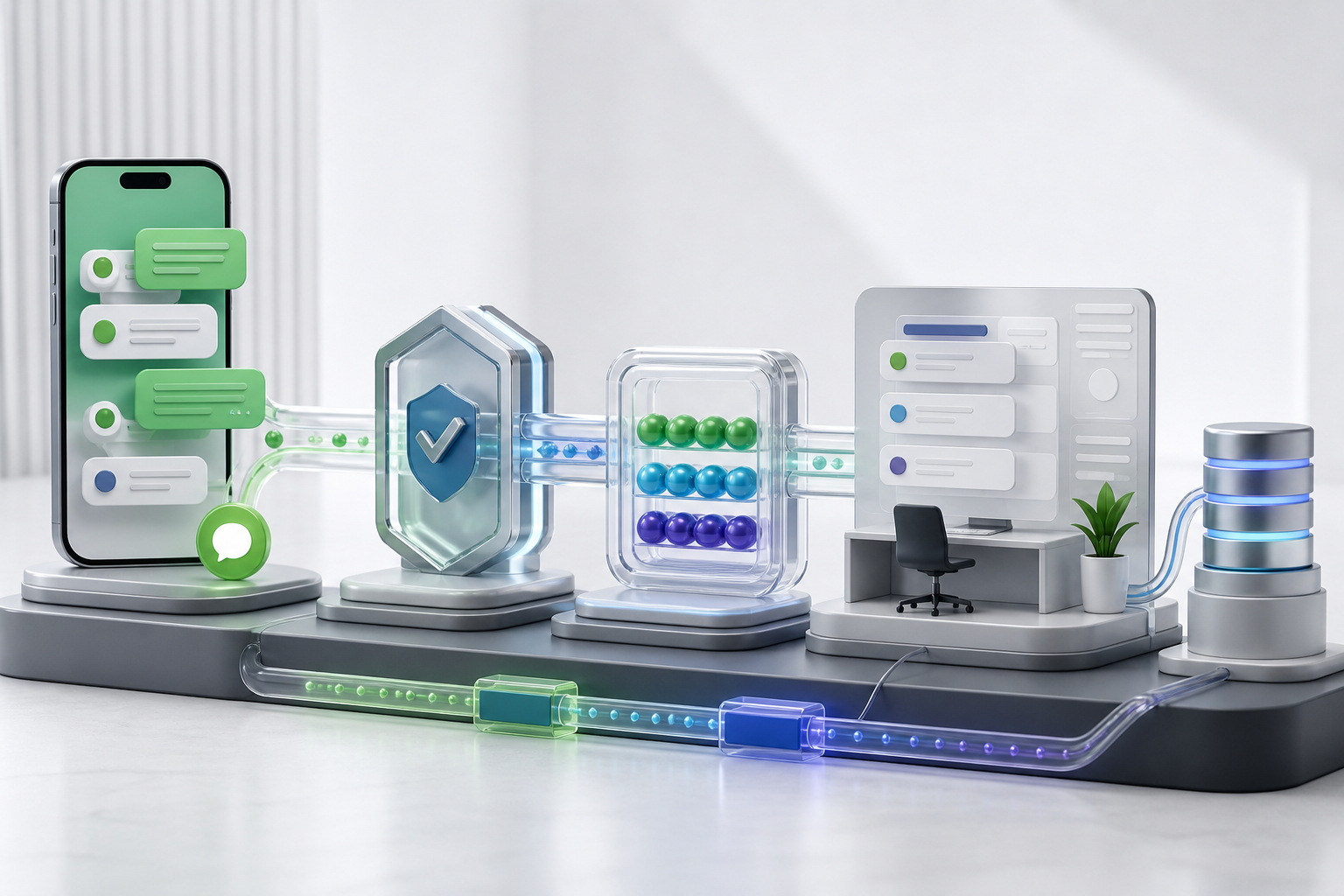
The API and your application are separate systems
With the official WhatsApp Business Platform Cloud API, Meta operates the messaging API. Your business still needs an application that receives webhooks, decides what to do with each event, stores approved business data and connects conversations to support, sales or automation workflows.
That application layer can run on a VPS under your control. The server does not replace Meta's platform, number registration or account approval. It provides the secure integration environment between WhatsApp and the systems your team already uses.
What normally runs on the VPS
A production integration is more than one webhook file. It needs a public HTTPS endpoint, validation logic, asynchronous processing and a controlled connection to customer data.
Separating these responsibilities makes the system easier to secure, monitor and recover when an external API or internal dependency is temporarily unavailable.
- An HTTPS webhook endpoint for inbound messages and delivery events.
- A queue or worker that processes events outside the webhook response.
- A database for permitted conversation state, routing and audit records.
- A CRM, helpdesk or order-system connector.
- Monitoring, structured logs and failure alerts.
- A controlled outbound service for approved message requests.
Design webhooks for retries and duplicates
Webhook delivery is event-driven. Your endpoint should acknowledge valid requests quickly and move heavier work to a background queue. Slow database calls, AI processing or third-party CRM requests should not block the initial response.
Assume an event may arrive more than once. Store a stable event identifier and make processing idempotent so a retry does not create duplicate tickets, orders or customer replies.
- Validate the webhook request before accepting it.
- Return the expected response promptly.
- Queue work that may take more than a brief request cycle.
- Deduplicate events before applying business actions.
- Retry temporary failures with limits and backoff.
- Move repeatedly failing events to a review queue.
Protect tokens and customer data
Access tokens, app secrets and verification values belong in protected server-side configuration, never browser code or public repositories. Limit which service account can read them and rotate credentials through a documented process.
Collect only the conversation and customer data your workflow actually needs. Define retention, staff access and deletion rules, and keep sensitive logs away from public dashboards. Server control improves your options, but it does not remove privacy or platform obligations.
- Use HTTPS and restrict administration interfaces.
- Keep secrets outside application source code.
- Apply least-privilege database and staff permissions.
- Encrypt backups and test restoration.
- Avoid logging complete tokens or unnecessary message content.
- Patch the operating system and integration dependencies.
Meta still controls platform approval and messaging rules
Hosting cannot bypass WhatsApp Business Platform registration, quality controls, messaging limits, customer consent requirements or template review. Those controls remain with Meta and the business account.
Plan automation around approved use cases and current platform documentation. A technically working server cannot protect a number from restrictions caused by prohibited content, unsolicited messaging or policy violations.
Build for operational continuity
A useful production design includes health checks for the webhook, queue depth, worker failures and outbound API errors. Alerts should tell an operator what failed and which events still need processing.
Back up configuration and required application data independently of the VPS. Document how to rotate a token, replace a failed worker, move the webhook and replay safely retained events after recovery.
- Monitor endpoint availability and certificate expiry.
- Alert on growing queues and repeated API errors.
- Keep deployment and rollback procedures versioned.
- Test recovery without sending duplicate customer messages.
- Separate development and production credentials.
Where InvisibleHosts can help
InvisibleHosts can provide the VPS foundation, managed operating support and implementation assistance for the customer-owned integration layer. Depending on scope, that can include server setup, reverse proxy and TLS configuration, webhook deployment, queues, databases, monitoring, backups and migration from another host.
Meta account approval, phone-number eligibility, templates and platform policy decisions remain outside the hosting provider's control. We design the infrastructure around the approved account rather than promising a shortcut around it.
- Regular or managed VPS sized for the webhook and worker workload.
- Secure deployment of a custom Node.js, Python or containerized integration.
- CRM, ticketing or order-system connection work under an agreed project scope.
- Monitoring, patching and recovery support for managed deployments.
Plan the workflow before choosing a server
Map the conversation journey first: what starts the interaction, which data is required, where an agent takes over and what should happen when an external service fails. Then size the server around expected message volume, worker concurrency, database use and retention.
Share the intended workflow, integration stack and expected daily conversation volume with InvisibleHosts if you need a scoped infrastructure or development recommendation.